BOBBY SHERMAN (1943-2025)
The son of a milkman, he showed a talent for music at an early age. He sang and learned to play a number of instruments, seeing performing as a way to overcome his shyness. Like a lot of people, he joined a band in high school and hoped to break in to the entertainment industry. Studying psychology at a community college, he got his break when a date invited him to a cast party for the soon-to-be released 1965 biblical epic
The Greatest Story Ever Told.
Held at Sal Mineo's house, the party had a lot of big Hollywood names in attendance - along with a band that included a couple of members of Sherman's high school band. They needed a singer, and invited Sherman to join them on a couple of numbers. With his rendition of “What’d I Say” by Ray Charles, he caught the attention of movie stars Natalie Wood and Jane Fonda. Along with Mineo, they approached him at the end of the song. One of them said, "You’re very good. Who’s handling you?" Since he didn't yet have a career, Sherman had no agent or manager or anyone "handling" him.
Shortly thereafter, Mr. Sherman received a phone call from an agent. He became a house singer on the variety show
Shindig! and began making appearances on TV programs such as
The Monkees. Stardom came when he landed a co-starring role on
Here Come The Brides (a Western set in the logging boomtown of Seattle, where logging executives decide to recruit marriageable women to stave off loneliness among the lumberjacks) in 1968.
The next year he launched an even more successful singing career, with hits including "Easy Come, Easy Go" and "Julie, Do Ya Love Me". For a while, the teen heartthrob was everywhere - posters, T-shirts, cereal boxes, lunch boxes.... After one performance, he had to sneak away in a hearse while fans mobbed a decoy limo.... Musical success eventually stopped, but he kept making TV appearances through the 1980s.
After his star faded, he chose an interesting second career. After taking a Red Cross class to learn how to care for his two sons if they were injured, he received his certification as an EMT. He joined the Los Angeles Police Department and instructed police academy trainees in first aid and CPR, becoming in the course of his work a sworn police officer and the department’s chief medical training officer. He also founded a volunteer EMT foundation, and, with his second wife, the Brigitte and Bobby Sherman Children’s Foundation, providing educational and nutritional services in Ghana.
Even in his new career, he still had his fans. One day, “we were working on a hemorrhaging woman who had pa
ssed ou
t,” he told the Los Angeles Times. “Her husband kept staring at me. Finally he said, ‘Look, honey, it’s Bobby Sherman!’” The woman quickly came to and exclaimed, “Oh great, I must look a mess!” “I told her not to worry, she looked fine,” Mr. Sherman recounted. He then signed an autograph before the ambulance whisked her away.
"Little Woman" (1969)

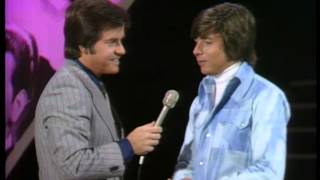
Interviewed by Dick Clark (1973?)
And yes, cereal boxes - complete with cheap but playable record on the back.